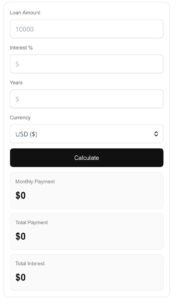
EMI (Equated Monthly Installment) is a fixed monthly amount you pay after taking load from a bank or some kind of financial institutions. These payments are applied to a specific period of time covering both the borrowed amount and the interest.
An EMI Calculator helps borrowers calculate their monthly installment before applying for a loan. It works on PRN formula as by inputting your loan amount, interest rate and repayment time, you can see how to pay every month. It saves time and help people choosing their loan.
EMI Calculator
Calculate your monthly EMI instantly
₹1,37,411
₹6,37,411
Loan Summary
| Loan Amount | ₹5,00,000 |
| Interest Rate | 10% |
| Loan Tenure | 5 Years |
| Monthly EMI | ₹10,624 |
| Total Interest | ₹1,37,411 |
| Total Payment | ₹6,37,411 |
Managing loans without understanding monthly repayments can quickly lead to financial stress. Whether you are applying for a home loan, car loan, personal loan, or business financing, knowing your monthly installment beforehand helps you make smarter financial decisions. That is where an EMI Calculator becomes extremely useful.
An EMI Calculator is one of the most important financial planning tools for borrowers in 2026. It helps users estimate their monthly loan payments instantly based on loan amount, interest rate, and repayment tenure. Instead of manually calculating complex formulas, borrowers can get accurate repayment estimates within seconds.
Financial experts and banks worldwide recommend using EMI calculators before taking any type of loan because they improve budgeting, repayment planning, and financial clarity. With rising loan options and varying interest rates, borrowers today rely heavily on digital financial calculators for informed decision-making.
What Is an EMI Calculator?
An EMI Calculator is an online financial tool that calculates the Equated Monthly Installment (EMI) you need to pay every month toward a loan. It provides an estimate using three main values:
- Loan Amount
- Interest Rate
- Loan Tenure
The calculator instantly shows:
- Monthly EMI amount
- Total interest payable
- Overall repayment amount
EMI stands for “Equated Monthly Installment,” meaning a fixed amount paid every month until the loan is fully repaid.
The standard EMI formula used by most banks and financial institutions is:
EMI=(1+R)N−1P×R×(1+R)N
Where:
- P = Principal loan amount
- R = Monthly interest rate
- N = Loan tenure in months
Although the formula looks complex, modern EMI calculators perform the calculation instantly and accurately.
How Does an EMI Calculator Work?
An EMI Calculator works by analyzing the principal amount, applicable interest rate, and repayment duration to estimate monthly payments. Once users enter these values, the tool automatically processes the formula and displays accurate repayment data.
For example:
- Loan Amount: $20,000
- Interest Rate: 10%
- Tenure: 5 Years
The calculator immediately estimates:
- Monthly EMI
- Total Interest
- Total Repayment
This helps borrowers compare multiple loan options before making a final decision.
Why Is an EMI Calculator Important for Borrowers?
An EMI Calculator helps borrowers avoid financial uncertainty by providing clarity before taking a loan. It allows users to plan budgets, compare lenders, and understand long-term repayment obligations.
Major Benefits of EMI Calculators
1. Better Financial Planning
Borrowers can check whether a loan fits comfortably within their monthly income and expenses.
2. Instant Loan Comparison
You can compare different banks, interest rates, and tenures without manual calculations.
3. Saves Time
Manual EMI calculations are complicated and time-consuming. Online calculators provide results instantly.
4. Reduces Financial Risk
Understanding repayment obligations beforehand reduces the chances of loan default.
5. Accurate Results
Most professional EMI calculators use standard banking formulas for reliable calculations.
6. Helps Improve Budgeting
Users can adjust tenure or loan amount to find manageable monthly installments.
What Types of Loans Can Use an EMI Calculator?
An EMI Calculator can be used for almost every installment-based loan available today.
Common Loan Types
- Home Loans
- Personal Loans
- Car Loans
- Education Loans
- Business Loans
- Gold Loans
- Bike Loans
- Consumer Durable Loans
Different calculators may also include advanced options like processing fees, prepayment calculations, and amortization schedules.
How to Use an EMI Calculator Step by Step
Using an EMI Calculator is simple and beginner-friendly. Most tools require only a few inputs.
Step 1: Enter Loan Amount
Input the total amount you want to borrow.
Step 2: Add Interest Rate
Enter the annual interest rate offered by the lender.
Step 3: Select Loan Tenure
Choose the repayment period in months or years.
Step 4: View Results
The calculator instantly displays:
- Monthly EMI
- Total Interest Payable
- Total Repayment Amount
Some advanced calculators also provide charts and repayment breakdowns.
EMI Calculator vs Manual Calculation
An EMI Calculator is significantly faster and more accurate than manual calculations.
| Feature | EMI Calculator | Manual Calculation |
|---|---|---|
| Speed | Instant | Slow |
| Accuracy | High | Risk of Errors |
| User Friendly | Yes | Complex |
| Loan Comparison | Easy | Difficult |
| Time Saving | Excellent | Poor |
Because of these advantages, online EMI calculators have become essential tools for modern borrowers.
What Factors Affect EMI Amount?
Several financial factors influence your monthly EMI payment.
1. Loan Amount
Higher loan amounts increase monthly installments.
2. Interest Rate
A higher interest rate results in higher repayment costs.
3. Loan Tenure
Longer tenures reduce monthly EMI but increase total interest paid.
4. Processing Fees
Some lenders add extra charges that impact total borrowing cost.
5. Prepayments
Partial repayments during the loan period can reduce EMI or tenure.
Understanding these factors helps borrowers make financially smarter choices.
Expert Tips to Reduce Your EMI
Borrowers can lower their monthly installment burden using smart financial strategies.
Smart EMI Reduction Tips
- Choose longer repayment tenure carefully
- Compare multiple lenders before applying
- Maintain a good credit score
- Make higher down payments
- Consider balance transfer options
- Use prepayments whenever possible
Financial advisors often recommend keeping total EMIs below 40% of monthly income for better financial stability.
Are EMI Calculators Accurate?
Yes, most EMI calculators are highly accurate because they use standard financial formulas followed by banks and lending institutions. However, actual loan repayments may slightly differ depending on:
- Processing charges
- Insurance costs
- Floating interest rates
- Additional taxes or fees
Therefore, borrowers should always confirm final repayment details with the lender.
Frequently Asked Questions
What is the full form of EMI?
EMI stands for Equated Monthly Installment.
Is an EMI Calculator free to use?
Yes, most online EMI calculators are completely free and accessible anytime.
Can EMI calculators be used for home loans?
Yes, EMI calculators are commonly used for home loans, car loans, personal loans, and education loans.
Does loan tenure affect EMI?
Yes. Longer loan tenure reduces monthly EMI but increases total interest payable.
Are EMI calculators accurate for all banks?
Most calculators provide close estimates, but final values may vary slightly depending on lender policies and fees.
Can I reduce my EMI after taking a loan?
Yes. You can reduce EMI through prepayments, refinancing, or extending loan tenure.
Conclusion
An EMI Calculator is an essential financial planning tool for modern borrowers. It simplifies complex loan calculations, improves budgeting, and helps users make informed borrowing decisions. Whether you are planning a home loan, personal loan, or car financing, using an EMI calculator before applying can save both money and financial stress.
As digital financial tools continue evolving in 2026, borrowers are increasingly relying on EMI calculators for smarter and safer loan management. By understanding monthly repayment obligations in advance, users can avoid unnecessary debt pressure and maintain better financial control.